The Mistake of Calling Every Long Performance Improvised
Long performance improvisation is rarely invention without limits; learn to hear how trained forms, shared conventions and spontaneous choices shape a musical unfolding.
When a performance stretches across a long span, is the musician making it all up as they go? Long performance improvisation can involve genuine spontaneity, but length alone does not tell you how much is invented in the moment. In many eastern musical traditions, a performer works within learned forms, characteristic gestures and expectations about how a piece may unfold. The freedom is real, but it has a setting.
That distinction matters because “improvised” can sound like “unprepared”. A long solo may instead resemble a conversation in which the speaker knows the language, the subject and the conventions of turn-taking, while choosing each phrase in response to the moment. To hear that balance, it helps to listen repeatedly with one modest question at a time, rather than trying to identify every note or name every form.
A week of attentive listening
Set aside a week for one recording of an extended performance. Choose a version that names the tradition, performers and form where those details are available. A raga performance, a Persian dastgah, or a long-form improvisation in another regional tradition may offer a useful starting point, but each carries its own rules; do not assume that what you hear in one applies to another.
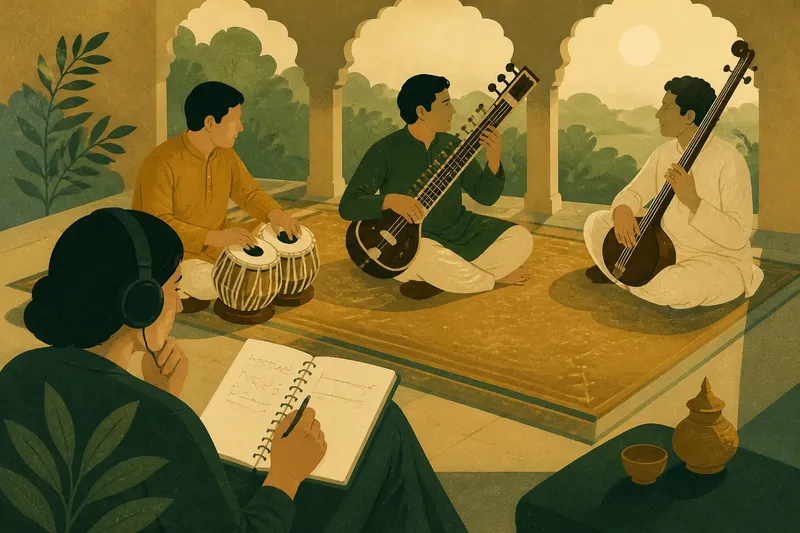
Use the same recording throughout the week. A pair of headphones can help with quiet details, while a notebook lets you mark broad changes without stopping to transcribe. The aim is not to turn listening into an examination. It is to notice what remains stable, what changes, and how the performer seems to move between the two.
Day one: hear the whole arc
Listen once without pausing. Note where the sound seems to settle, gather momentum, become more animated or draw towards an ending. Keep the descriptions ordinary: “the phrases become busier” is more useful at this stage than a technical term you are not sure you understand.
On a second pass, mark a few turning points by their position in the recording, not by exact timestamps. Ask whether a new section seems to begin, or whether the same material is being varied. A long performance can develop gradually, so a shift in energy does not necessarily mean the music has entered a wholly new form.
Day two: listen for what returns
Attend to recurring phrases, melodic shapes, rhythms or characteristic turns. You may hear a small gesture reappear with different emphasis, or a phrase that seems to invite a particular kind of response. Write down what you can recognise by sound, without deciding yet whether it is a fixed motif or a spontaneous invention.
Imagine a listener following a recording of a raga-based performance who notices that a certain melodic figure returns after several exploratory passages. They mark the figure and later hear it altered in a more animated section. The observable result is a clearer sense of continuity: the music no longer sounds like a succession of unrelated ideas, even though the performer has not simply repeated the same phrase.
Day three: separate frame from choice
Listen for the broad structure around those returning gestures. Depending on the tradition and performance, there may be an opening that introduces a tonal world, a gradual increase in rhythmic activity, a recurring composition, or an exchange with percussion. These are possibilities, not a universal sequence. The useful question is whether the performance seems to follow an established path, and what evidence in the sound supports that impression.
Think of the form as a room with doors rather than a track laid down in advance. The room’s shape constrains where one can go, but it does not dictate every movement. This everyday comparison is imperfect, yet it helps distinguish a shared framework from a fully predetermined sequence.
Day four: notice the trained vocabulary
Listen for choices that sound idiomatic: ornamentation, characteristic approaches to a note, rhythmic patterns, or ways of extending a phrase. In a tradition, such gestures are not merely decorative additions. They can signal a particular musical identity and show that a performer has absorbed conventions through study and practice.
Try noting a gesture in plain language, such as “the line circles back before settling” or “the phrase stretches, then answers itself”. If you later consult a programme note or a reliable description of the tradition, compare its terminology with what you heard. Labels can sharpen attention, but they should not replace it.
Day five: follow the moment-to-moment decisions
Now listen for what may be newly chosen in response to the performance itself. A musician might lengthen a phrase, delay a landing, alter the density of a passage, or answer a percussionist’s cue. The recording alone may not reveal the musician’s intention, so treat these as audible possibilities rather than claims about what was in their mind.
Notice how a choice relates to what came before. A surprising pause may make a familiar gesture feel newly exposed; a denser run may answer a rhythmic push. Spontaneity is often most audible not as something unrelated to the form, but as a decision made within it.
Day six: listen to the exchange
If other musicians are present, focus on how they share attention. A drone instrument may sustain a tonal centre, percussion may shape the rhythmic conversation, and accompanying musicians may echo or support a soloist. Their roles differ across traditions and ensembles, so listen for the specific relationship in this recording rather than assuming that one performer alone controls the unfolding.
Replay a short passage where the texture changes. Ask who initiates the change, who responds, and whether the exchange shifts the energy or simply colours it. You may not be able to tell from sound alone, but the question helps you hear performance as a social act as well as an individual display.
Day seven: return to the whole
Listen once more without notes. Compare the experience with your first day: does the performance now have a clearer arc, or do its recurring details feel more audible? You need not settle every uncertainty. A good listening account can include both a firm observation and an honest “I cannot tell”.
What does improvisation mean here?
Is a long performance composed in advance?
Sometimes particular sections, melodies or rhythmic patterns are composed or agreed beforehand, while other parts allow room for choice. The balance varies by tradition, ensemble and performance, so “composed” and “improvised” are not always opposing categories.
Can a performer repeat the same form?
A performer may return to a familiar form or follow conventions that shape its progression, while varying details from one performance to another. Similarity does not by itself mean the music is mechanically fixed.
Does spontaneity mean anything can happen?
No: spontaneous choices are usually made from a learned musical vocabulary and within expectations shared by performers and listeners. A choice can be fresh without being arbitrary.
How can a listener hear the difference?
Listen for recurring material, sectional changes, characteristic gestures and exchanges between musicians. These clues can suggest where a framework is active, though they may not reveal exactly which notes were planned or newly chosen.
From impression to listening
After the week, write a short description that separates observation from interpretation. For example: “A phrase returns in altered form” is an observation; “the performer is inventing freely” is a wider interpretation that may need more context. This distinction keeps your account precise without making listening feel cautious or bloodless.
When you describe long performance improvisation, name the tradition or form if you can do so confidently, then explain what the recording lets you hear. If the programme offers no context, say so rather than treating the sound as evidence of an absence of structure. The most useful question is not whether a performance is improvised, but where its conventions leave room for a musician to make the next choice.