When Music Was Learned by Listening
When music was learned by listening, a tune travelled through memory, imitation and correction. See how oral teaching carries detail between generations.
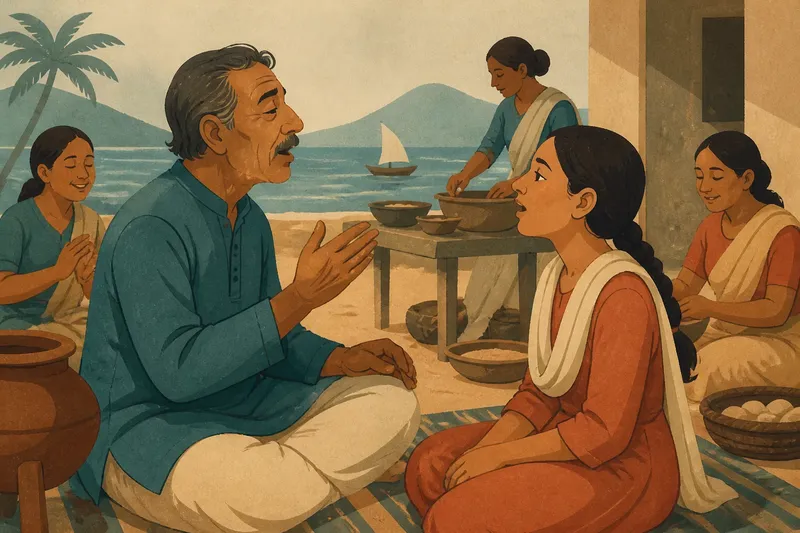
How can a musical practice pass between generations when nobody writes it down? When music was learned by listening, a learner had to attend to more than a sequence of pitches: the sound’s timing, tone, phrasing and place in a social setting all came through hearing and doing. Imagine a young learner in an invented coastal village, sitting beside an older relative who sings while preparing a family gathering. That small scene lets us follow how oral learning works—not as a substitute for notation, but as a way of carrying musical knowledge through relationships, repeated encounters and shared use.
A tune in its setting
In this imagined village, the learner, Mira, has heard the family song at gatherings since childhood. Familiarity, however, is not the same as knowing how to sing it. Her relative, Arun, asks her to join when the song begins. Mira catches the general contour, but enters late and smooths a sharply marked syllable into the surrounding phrase. Arun does not hand her a page or recite a theory. He sings the opening again, leaves space for her response, then repeats the passage with the disputed syllable clearly articulated.
The setting supplies clues that a bare string of notes would not. Mira hears when the song begins in relation to the gathering, which words receive weight, how the singers breathe together and what kind of mood the piece serves. She also sees how Arun’s mouth shapes its sounds and notices when other relatives join. The song is not simply a tune to retrieve; it is an action fitted to a social occasion.
That distinction matters across oral traditions. A learner may absorb a melody in a work setting, a ceremony, a household gathering or an informal lesson. Each setting gives the music a different frame: what counts as an appropriate entrance, which parts invite participation and how the sound relates to words, movement or shared attention. The circumstances vary, but the general lesson is consistent: listening takes place inside a practice, not outside it.
Repetition with attention
When Mira tries again, Arun asks her to listen for the short pause before the repeated phrase. She sings it back, initially too quickly. He repeats the phrase at its usual pace; she echoes him; then they sing it together. This cycle—hearing, attempting, comparing and hearing again—is more than rote repetition. Each return gives Mira a chance to focus on a particular feature without losing the phrase’s relation to the whole.
A listener can attend to different things on different passes. One time, Mira follows the melody’s rise and fall. Next, she concentrates on where the words sit against the beat. Later, she notices the change in vocal colour at the phrase ending. These details need not be separated into formal lessons. A teacher’s demonstration, a learner’s attempt and a correction can happen within the flow of ordinary music-making.
Repetition also reveals what memory can and cannot yet hold. Mira remembers the opening but forgets how the next phrase connects to it. Arun gives her the transition, then returns to the opening so she can link the two. If she consistently loses a word, the singers may repeat that line with the text spoken first or sung more slowly. The response is specific to what needs attention; it does not require turning the whole song into a mechanical drill.
Think of learning the tune as handling a familiar cup: its shape is recognisable, but a person still needs practice to lift and use it without spilling. The analogy is modest, yet useful. Recognising a song does not mean the body has learnt when to breathe, how to shape its words or how to move from one phrase to another.
Memory carried between people
In an oral practice, memory is not held by one learner alone. Mira can hear the song from several relatives, each with a slightly different voice and way of leading. Arun may emphasise a word that another singer lets pass lightly. One relative might prompt a missed entrance; another might add the response that follows. Their participation gives Mira more than repeated exposure: it makes the song available through a network of listeners and singers.
That network can make room for variation. If a melody changes slightly between households, a learner may hear more than one familiar version. Such variation is not automatically a mistake, nor does it mean that anything may be changed without consequence. A community may value a particular phrasing, text or order, and people who know the practice can hear when a choice sits outside its conventions. The boundaries are learned through attention to how the music is used and answered.
In Mira’s case, she learns a phrase from Arun but also hears her aunt lead it at a gathering. The aunt lengthens one word to let the group catch up. Mira understands that this is a responsive choice, not a fixed part of the song in every setting. When she sings with the family, she must listen for the group’s pace rather than cling to the version she first memorised.
Listening therefore carries both continuity and judgement. The learner hears what is shared, notices how performers adapt, and gradually learns which details may shift and which are treated as defining. That judgement is rarely delivered as a list of rules. It grows through correction, participation and the chance to hear a practice in more than one situation.
Correction without a page
Suppose Mira now sings the complete song at a family gathering. She remembers the words but rushes the response, so the other singers come in after her. Arun does not stop the gathering to lecture. Later, he sings that passage with her again, leaving a clear space where the group’s response belongs. At the next opportunity, Mira waits and listens before entering. The observable result is not merely a cleaner performance: she has begun to understand how her part depends on other people’s timing.
Oral correction can use contrast as well as explanation. A teacher may sing a phrase as the learner gave it, then sing the established version, making the difference audible. They might tap a pulse, speak a line, or ask the learner to listen to another singer’s breath. These are ways of directing attention, not universal procedures. What helps depends on the music, the learner and what the community considers important.
Not every correction is verbal. A leader may repeat a passage until the group settles into it, or a singer may adjust their volume so a learner can hear the line more clearly. The learner’s own listening matters too: noticing that an entrance does not fit, asking for a phrase again, or comparing how different singers deliver it. Responsibility is shared, though teachers and experienced performers often carry particular authority.
Without a written score, there may be no single external page against which to check a performance. That does not mean the music is vague or unstructured. The community itself can hold finely developed expectations, carried through its singers and occasions. A learner is accountable to what those people hear and recognise.
What notation leaves open?
Written notation can preserve musical information, support teaching and help a piece travel between people who are not in the same room. It can also make certain features easier to compare. Oral teaching offers a different emphasis: it lets sound arrive together with demonstration, response and local knowledge. These approaches need not be opponents. Musicians may use notation alongside listening, or rely on oral transmission for some parts of a practice and writing for others.
A page cannot, by itself, show every detail a learner may need to hear. Even a score that records pitch and rhythm may not make clear how a particular singer shapes a consonant, how a phrase relates to the room, or when a group should respond. A recording can preserve an audible performance, but it cannot answer a learner’s question or adapt its pace to a particular voice. Live teaching joins sound to interaction.
That is not a claim that oral memory is effortless or immune to loss. A practice can become harder to sustain if learners have fewer chances to hear it, if fluent singers are unavailable, or if the occasions that gave it meaning change. Written and recorded materials may help in such circumstances, but they work best when treated as supports for a living practice rather than as complete replacements for people who can explain and demonstrate it.
For Mira, a recording might help her revisit a phrase at home. When she returns to sing with Arun, she can ask whether her recollection fits the family’s version and learn how to join the group. The recording preserves one sound; the gathering teaches her how that sound belongs among other voices.
Where does oral learning begin?
Can adults learn music by listening?
Yes. Adult learners can begin by attending closely, asking for a phrase again and trying it aloud rather than waiting to feel fully confident. A patient teacher or community setting can help them hear what to adjust while respecting the practice’s local expectations.
Does oral learning mean there is no structure?
No. A song may have a recognised order, phrasing, text or set of responses even if those conventions are not written down. Learners encounter that structure through repeated performance and feedback from people who know the tradition.
Can recordings support oral teaching?
They can preserve an audible version for later listening, particularly when a learner wants to revisit a detail. A recording cannot respond to an attempt, explain a local convention or show whether a phrase changes with the people and occasion.
How should a learner approach variation?
Listen to several knowledgeable performers and ask which differences are accepted in the relevant setting. Avoid treating every change as either an error or permission to alter the music freely; the people who sustain the practice can explain its boundaries.
A practice passed on
Return to Mira at a later gathering. She now knows the song well enough to lead its opening, yet she still watches and listens for the group’s response. When a younger cousin asks how the phrase goes, Mira sings it, leaves space for an echo and corrects the entrance by repeating the passage rather than naming an abstract rule. The cousin learns not just a sequence but a way of joining in.
This is the quiet strength of learning music by listening: knowledge moves through people who make sound together, notice differences and offer one another another chance to hear. Mira’s progress depends on attention and repetition, but also on the family’s willingness to sing, respond and explain. When music was learned by listening, its continuity rested not in memory alone but in the relationships and occasions that kept memory in use.
For anyone trying to understand an oral tradition, the most useful question is not only what notes the music contains, but who teaches it, where it is heard and how a learner is invited to answer. Those details show how a musical practice remains recognisable while living in the voices of successive generations.